

TV commercial production cost in Chennai starts at roughly ₹2–5 lakh for a simple, single-location spot made by a professional crew, sits between ₹8 lakh and ₹25 lakh for a well-planned regional or business-focused TVC, and runs from ₹25 lakh to ₹60 lakh for a broadcast-standard national commercial. Celebrity-led campaigns go well past ₹1 crore. Those are production figures only, drawn from current published guides by Indian production houses, and the ranges are wide because the word “commercial” covers everything from a one-day studio shoot to a four-day, multi-city production with a specialist post pipeline.
What moves the number is not duration. It is creative complexity, cast, shoot days, locations, usage rights and how much post-production the idea needs. The second thing to settle before you read any further: making the advertisement and buying television airtime are two separate budgets. A production quote almost never includes the cost of broadcasting the film, and media is usually the larger of the two.
Table of Contents
How Much Does TV Commercial Production Cost in Chennai?
Published guides disagree, and the disagreement is instructive. Cybertize Media’s 2026 TVC cost guide puts a basic, entry-level commercial at ₹2–8 lakh and a mid-range production at ₹8–25 lakh, airtime excluded. First December Films, a Mumbai production house, says a ₹3–8 lakh film is social content rather than a TVC, that lower-budget regional TVCs start around ₹8 lakh, and that most national 30-second commercials are produced for ₹25–60 lakh.
Both are describing real projects. The gap is scope. The ₹2–8 lakh film has one location, a small crew, a short cast list and library music. The ₹25 lakh film has a director with a reel, a cinematographer, two to four shoot days, built sets or premium locations, professional casting, and a grade and sound mix done by specialists. Regional channels in Tamil Nadu or Karnataka will happily air the first kind. A national GEC campaign is normally built at the second level.
So the honest answer to “how much” is a question back: which kind of commercial, running where, for how long, with whom in it?
TV Commercial Production Cost by Budget Tier
The table below reconciles the published ranges into four working tiers. Every figure is a production estimate from the named source, excludes airtime, and should be read as a planning band rather than a quote.
| TV commercial production tier | Indicative production budget | Typical scope | Includes talent, music, VFX? | Source and date |
| Simple, single-location TVC | ₹2–8 lakh | One location, one shoot day, small professional crew, limited cast, clean edit and grade, library or stock music; suitable for regional and cable channels | Local talent yes; no celebrity; stock music; little or no VFX | Cybertize Media, Mar 2026; Cybertize Delhi guide (broadcast-ready from ~₹4 lakh), Sep 2026 |
| Standard regional or business-focused TVC | ₹8–25 lakh | Director and cinematographer, one to two shoot days, planned casting, art direction that holds in close-up, considered grade, original or licensed music, several durations and language versions | Professional actors yes; music licensed; light VFX or clean-up | First December Films, Aug 2026; Cybertize Media mid tier, Mar 2026 |
| Larger national campaign | ₹25–60 lakh | Broadcast standard: two to four shoot days, crew of 40–80, cinema camera packages, built sets or premium locations, specialist colourist and sound designer, multiple language versions | Shortlisted professional cast; original score or licensed track; real VFX where the idea needs it | First December Films, Aug 2026 (national TVC tier); Cybertize Media premium tier ₹25 lakh–1 crore+, Mar 2026 |
| Premium or celebrity-led TVC | ₹75 lakh to several crore | Mainstream celebrity, difficult or international locations, large art department, weeks in post, campaign shot as a series of films | Celebrity endorsement fee usually on top of the production figure; licensed or composed music; extensive VFX | First December Films (production from ~₹75 lakh before the endorsement fee), Aug 2026; Cybertize Media celebrity tier ₹1–5 crore+, Mar 2026 |
Two cautions. A lower tier does not mean a weak film; a tightly written single-location idea shot by a good small crew can out-perform an expensive one. And a higher tier does not guarantee results; what the money buys is control: preparation time, the right specialists, room on the schedule to go again, and insurance against a bad shoot day.
What Factors Affect TV Commercial Production Cost?
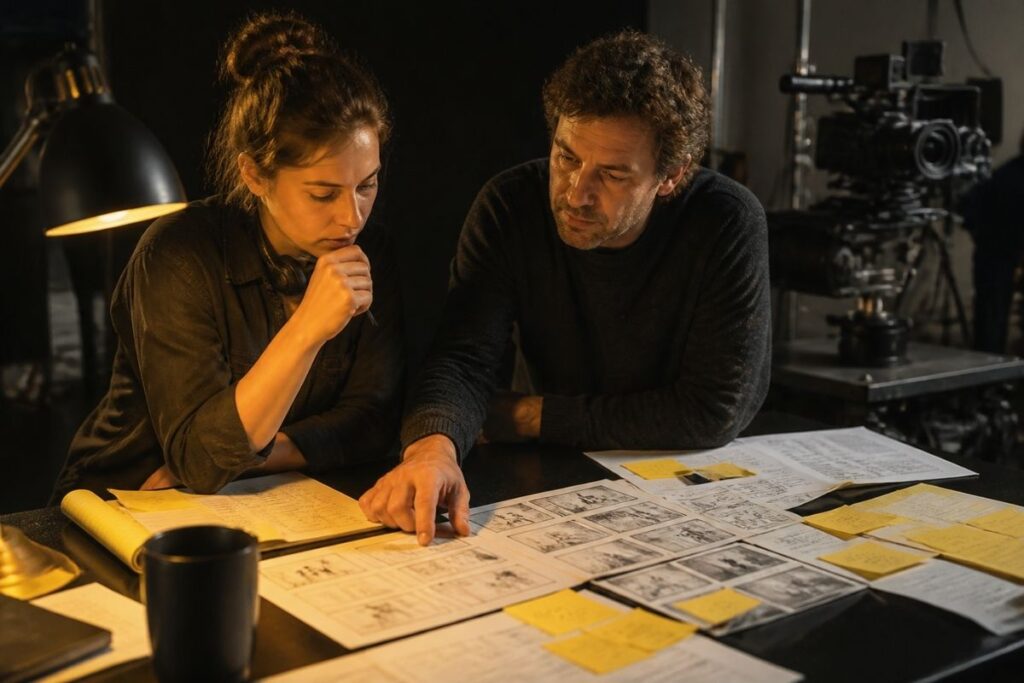
Creative Concept and Script
Cost is decided at the script stage, not the quote stage. Three locations, a crowd scene and a night exterior are not a ₹10 lakh script however good the writing is. Published line-item ranges for script development run from about ₹15,000 for a straightforward concept to ₹1.5 lakh for an agency-led, multi-round process.
Director and Cinematographer
A director’s fee is one of the biggest single lines and one of the biggest quality determinants; published guides put it anywhere from ₹30,000 to ₹3 lakh and above per project, depending on the reel. The cinematographer (DOP) is priced similarly by experience.
Production Crew and Shoot Days
Every shoot day is a full crew day: camera, lighting, grip, sound, art, production and transport. One extra day is never a small bump. Cybertize’s guide puts camera, lighting and equipment at ₹50,000–2.5 lakh per shoot day depending on the package.
Actors, Presenters and Celebrity Talent
Local professional actors can start around ₹10,000–20,000 a day; experienced commercial actors run into lakhs, and a celebrity face is a separate negotiation that can exceed the rest of the production combined. Talent cost also depends on usage rights (below), not just the day rate.
Locations, Travel and Permissions
A studio day, a rented bungalow and a beach shoot with police coordination are three different budgets. Permissions take time as well as money; budget for the day they do not come through.
Equipment, Lighting and Grip
Above roughly ₹8 lakh, equipment is rarely the constraint. Cameras have been broadcast-capable for years. What changes is the lighting and grip package needed to make a set look the way the storyboard promised.
Sets, Styling and Art Direction
Product-led commercials live or die on art direction: the kitchen, the office, the pack shot table, wardrobe and props. A built set costs more than a dressed location, and both cost more than a plain backdrop.
Editing, Colour Grading and Sound
A clean edit with an in-house grade is light. A specialist colourist, a separate sound designer and a proper mix for broadcast add real cost, and that is where a lot of the gap between tiers sits.
Music Rights and Voice-over
Library music, an original composition and a licensed popular track are three different budgets, and a licence carries its own term and territory. Tamil and English voice-overs are usually recorded separately.
VFX, CGI and Animation
Clean-up (removing a wire, fixing a logo) is cheap. Product CGI, compositing and animation can cost more than the live shoot.
Language Versions and Deliverables
A 30-second hero film is one edit. The 20, the 10, the 6-second bumper, the vertical cut and the dubbed versions are each more work. Shooting them on the same day typically adds around 15–20% to the budget, against roughly double if they are produced separately, according to Cybertize’s Delhi guide.
Usage Rights and Licensing
The most under-explained cost on any quote. A talent contract for one year, India only, TV and digital, costs a fraction of three years, worldwide, all media. Renewing a lapsed term after the film has become a hit is the most expensive purchase in advertising.
TV Commercial Production Budget Breakdown
Production houses describe the budget in four buckets: pre-production (script, treatment, storyboard, casting, recce, permissions, scheduling), production (the shoot days), post-production (edit, grade, sound, music, VFX, versioning) and talent. Published splits vary with the project: one Mumbai house estimates pre-production at 10–15% of the total; another describes a 25% pre / 50% shoot / 25% post split for its own films. Treat those as orientation, not a formula.
The sample below is an illustrative budget, not a quotation from One Dot Direction or any other company and not a completed project. It is built to show how a mid-range regional commercial might be costed and to make the arithmetic visible.
Scenario: a 30-second product TVC for a regional consumer brand. One location (a rented house dressed as a home), one shoot day, two professional actors, a director and a DOP with a 15-person crew, Tamil and English voice-over, library music, 30/20/10-second cuts plus a vertical version, one-year India TV and digital usage.
| Budget line | Amount (₹) | What it covers in this scenario |
| Concept, script and storyboard | 60,000 | Two concept routes, final script, 12-frame storyboard |
| Pre-production | 50,000 | Casting session, location recce, permissions, schedule, art list |
| Director and DOP fees | 1,50,000 | One shoot day plus prep and post supervision |
| Crew (one shoot day) | 1,20,000 | Assistant director, focus puller, gaffer and lighting team, grip, sound recordist, production team |
| Camera, lenses, lighting and grip | 1,20,000 | Cinema camera package, lens set, lighting and grip hire for one day |
| Location hire | 60,000 | House rental for the day, cleaning, power |
| Art direction, props, wardrobe and styling | 70,000 | Dressing the set, product styling, costumes, make-up |
| Cast (two actors, one-year India TV and digital usage) | 1,00,000 | Day fee plus usage term |
| Edit and colour grade | 70,000 | Offline edit, online, grade, two revision rounds |
| Sound design, voice-over (Tamil + English) and library music | 60,000 | Mix for broadcast, two VO recordings, music licence |
| Versions and broadcast deliverables | 40,000 | 30/20/10-second cuts, 9:16 version, channel-spec masters |
| Production subtotal | 9,00,000 | |
| GST at 18% (commonly quoted separately) | 1,62,000 | Confirm the applicable rate with your accountant |
| Total payable | 10,62,000 | Airtime not included |
Change one assumption and the total moves: a second shoot day adds most of the crew, equipment and location lines again; a known regional face replaces the cast line with a far larger one; an original composition replaces library music; product CGI adds a VFX line that does not exist here. That is why a quote without a defined scope is not comparable to anything.
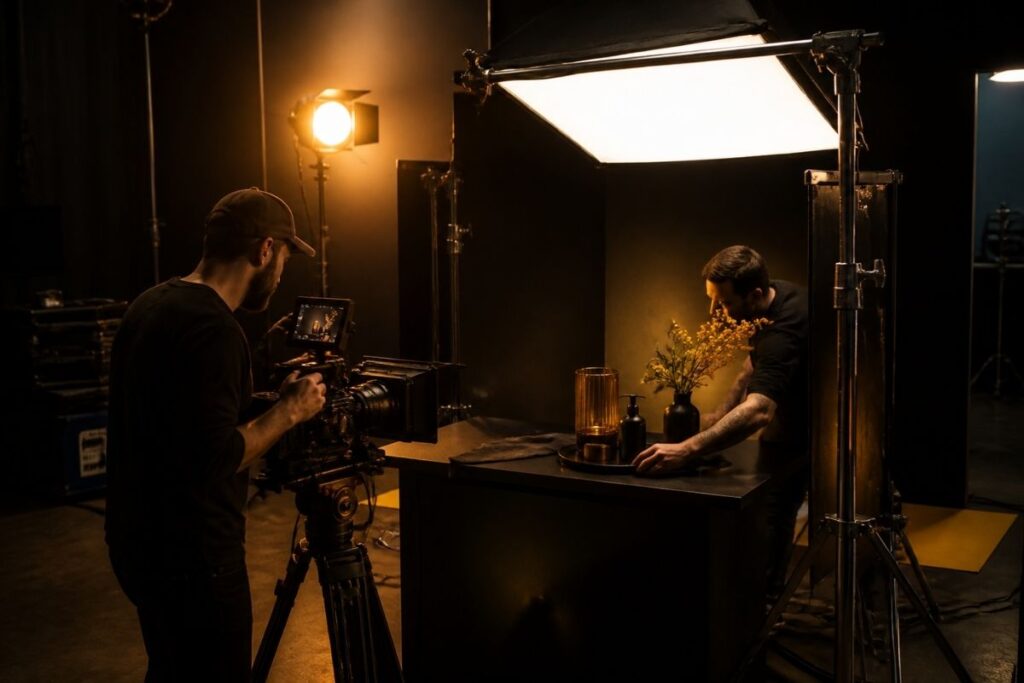
TV Commercial Production Cost vs TV Advertising Airtime Cost
Production cost is what you pay to make the advertisement. Media cost is what you pay to broadcast it. They are separate budgets, negotiated with separate people, and a production company is not responsible for airtime unless media buying is explicitly part of its service.
Media cost depends on the channel (a national Hindi GEC, a Tamil regional channel, a news channel, a sports property), the geography you want to reach, the audience profile, the time band (prime time costs several times an afternoon slot), the campaign period, the frequency you need for recall, and the rates your buyer negotiates against the card rate. Published guides also note that connected TV and OTT inventory can be bought alongside or instead of linear slots for the same film.
This article does not publish channel rate cards. Rates change by season and negotiation, and the figures circulating in production-house blogs are not verifiable. Ask a media agency or the channel’s sales team for current rates, and budget the film and the airtime as two lines from day one so you do not end up with a commercial you cannot afford to run.
Quotes also treat taxes, talent usage rights, music licensing and broadcast deliverables differently. One company’s “all-inclusive” number can be another company’s subtotal.
What Should a TV Commercial Production Quote Include?
Use this as a checklist when you compare proposals. The aim is to compare equivalent scopes, not final totals.
| Item | What to confirm |
| Creative development | Number of concept routes, who owns the idea, how many rounds |
| Script and storyboard | Included or extra; who approves; is a treatment provided |
| Pre-production | Casting sessions, recce, permissions, schedule, art list |
| Crew and equipment | Named key crew, crew size, camera package, lighting and grip |
| Shoot days and overtime | Hours in a shoot day, overtime rate, weather or contingency day |
| Talent fees and usage rights | Day rate, media, territory and term; renewal cost; celebrity entourage |
| Locations and permissions | Hire, permissions, police coordination, travel, meals |
| Editing and post-production | Offline, online, grade; specialist colourist or in-house |
| Music and sound | Library, licensed or composed; licence term; mix spec |
| VFX and graphics | Clean-up only or CGI and compositing; number of shots |
| Deliverables and broadcast formats | Durations, aspect ratios, language versions, channel-spec masters, subtitles |
| Revisions and approvals | Rounds included at script, offline and final; sign-off stages |
| Taxes and other charges | GST shown separately or inside; insurance; rush premium; raw footage handover |
When two quotes are far apart, the explanation is almost always that one covers two shoot days and the other one, or one includes grade and sound and the other does not. Ask for the gap to be explained line by line before you decide.
How to Plan a TV Commercial Budget More Effectively
- Define the objective and audience first. Awareness, launch or footfall decides the creative route and the channel plan, which decides the budget.
- Agree the core idea before production is priced. Ask for a treatment and a rough budget band against the script, then refine.
- Lock the script and storyboard before filming. Changes on set cost crew hours; changes in the edit cost reshoots.
- Confirm casting, locations and permissions early. Late approvals compress schedules, and compressed schedules cost money.
- Decide every duration and language version in advance. Shooting cut-downs and vertical frames on the same day is far cheaper than a second production.
- Plan realistic shoot days. A premium crew that finishes in one day is often cheaper than a cheaper crew over three.
- Settle usage rights at the quote stage. Media, territory and term for cast, music and voice.
- Consolidate feedback. One round of combined comments from marketing, sales and leadership beats three partial ones.
- Keep production and media as separate lines. Share your real budget with the production company; a house that knows the number designs a film that can be made for it.
A digital-first or AI-assisted commercial is worth considering when the campaign will not run on broadcast at all. Removing the shoot removes crew, cast, location and equipment, which is why published AI ad-film prices sit well below conventional TVC figures. For a campaign that does need television, the broadcast specification, the clearance paperwork and the usage terms still have to be built in.
Planning a Commercial Production with One Dot Direction
One Dot Direction is a Chennai creative media production company whose media production work covers commercial ads, brand films, corporate films, product shoots and reels, with concept, script, shoot and edit handled by one team. Its corporate brand film production runs from brief to final deliverables, including Tamil and English voice-over, cut-downs and vertical versions from the same shoot. For ideas that are bigger than a set or a location, its AI video ad production combines filmed product plates with generated environments.
There is no fixed TVC rate card, because there is no fixed TVC. A tailored quote needs the campaign objective, the intended channels, the duration and language versions, the creative treatment, cast and location requirements, deliverables and the timeline. With those in hand, the scope can be priced line by line in the format above, so the quote is comparable to any other you receive. If you are weighing a corporate film instead of an advertisement, the guide to corporate video cost in Chennai covers that pricing separately.
Frequently Asked Questions
How much does a 30-second TV commercial cost in India?
There is no single price for 30 seconds. Published guides range from about ₹2–5 lakh for a simple single-location spot to ₹25–60 lakh for a broadcast-standard national commercial, and higher with a celebrity. Shoot days, cast, locations and post-production set the price; duration mostly affects airtime cost and versioning.
What is the difference between TVC production cost and airtime cost?
Production cost is a one-time cost to make the film. Airtime is the recurring cost of each broadcast slot, set by channel, time band, geography, campaign length and negotiation. Budget both; media is usually the larger line.
Does TV commercial production cost include actors?
Usually it includes the day fees of the cast the production house proposes, but check whether usage rights (media, territory, term) are inside the number. Celebrity endorsement fees are almost always quoted on top of production.
Why do TV commercial production quotes vary so much?
Because the scope differs: one quote may cover two shoot days, a specialist grade and all deliverables; another one day and an in-house edit. Compare inclusions line by line before comparing totals.
Is music licensing included in a TVC production budget?
Sometimes. Library music is often included; an original composition or a licensed popular track is a separate budget with its own term and territory. Ask which it is.
How long does it take to produce a television commercial?
A simple regional spot can move from approved script to final master in about three to five weeks; a national production with built sets, multiple versions and specialist post commonly takes longer. Approval speed on the script and first cut moves the date more than anything else.
Can a regional brand produce a TV commercial on a limited budget?
Yes. A single-location, single-day production with a professional crew is what regional and cable channels run every day. Keep the idea tight, decide every version up front and spend on sound, lighting and the edit, which are what viewers notice.
Does the TV commercial need to clear any advertising standards?
Television advertising in India is expected to comply with the ASCI Code for Self-Regulation of Advertising Content, which the Cable Television Networks Rules reference. Claims, comparisons and disclaimers should be checked at script stage; a reshoot to fix a claim is far costlier than a rewrite.
Conclusion
The one budgeting principle that survives every tier: define the production scope first, then compare the inclusions, then compare the price. A number without a scope is not a quote. If you are planning a commercial and want the scope priced line by line, share the objective, channels, duration, treatment, cast and location needs, deliverables and timeline with One Dot Direction and we will come back with a quotation you can compare.